
How do you reconstitute retatrutide?
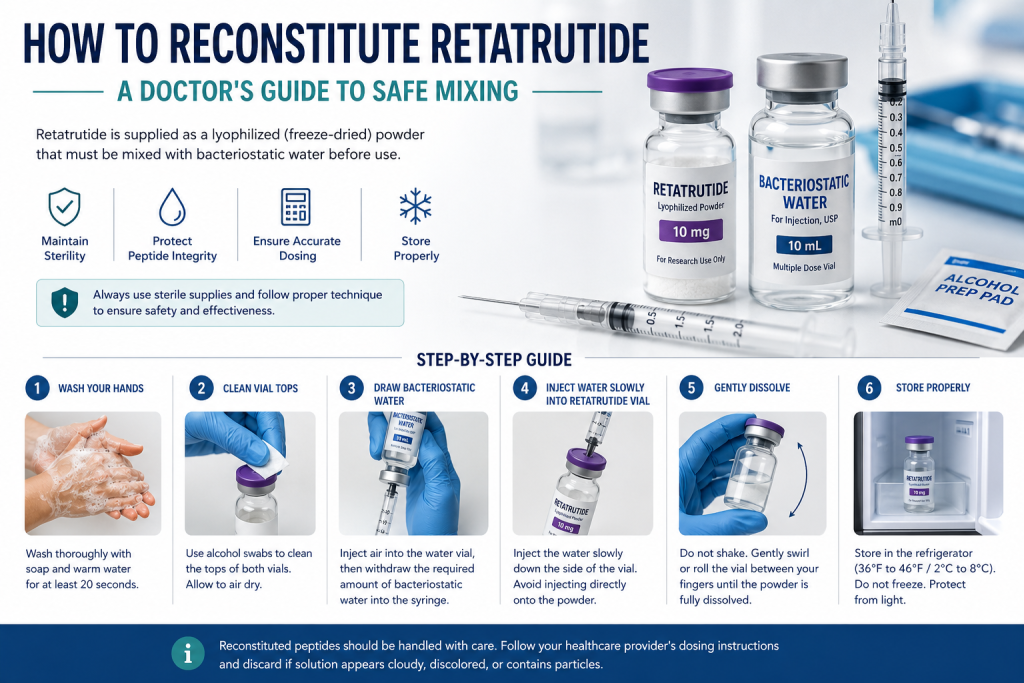
Retatrutide should not be reconstituted for personal use from an unlicensed vial using an internet dosing guide. There is no authorised UK patient-use retatrutide product with a standard public reconstitution protocol. If retatrutide is supplied in a legitimate clinical trial, preparation and administration must follow the trial’s approved protocol and be handled by the authorised research team.
Why are people searching for how to reconstitute retatrutide?
Searches for “how to reconstitute retatrutide” often come from people who have found a lyophilised powder vial online and want to turn it into an injectable solution.
That is where the main safety problem begins. A powder labelled “retatrutide” is not automatically a pharmaceutical product, and the correct preparation cannot safely be inferred from a social-media post, seller’s instructions or a generic peptide calculator. In the UK, authorities have specifically targeted unlicensed weight-loss medicines and alleged manufacturing operations involving retatrutide.
The practical question is therefore not simply, “How much liquid should be added?” It is whether the vial is authentic, whether it is intended for human use, whether the diluent is appropriate, whether sterility has been assured and whether the resulting preparation can be safely administered at all.
What is retatrutide, and why does reconstitution matter?
Retatrutide, also known as LY3437943, is an investigational medicine being studied for obesity and related metabolic conditions. It is designed to activate GLP-1, GIP and glucagon receptors, making it a distinct triple-agonist drug candidate rather than a routine, approved weight-loss medicine.
A lyophilised powder requires controlled preparation before it can become a usable injectable formulation. That process involves more than simply adding liquid. The identity and concentration of the active ingredient, the suitability of the diluent, sterility, container integrity, storage conditions and handling procedures all matter.
What this means: the same-looking vial can represent very different risks depending on its source and how it was manufactured. A calculation based only on milligrams and millilitres cannot verify product quality or sterility.
What is the safe answer to “how to reconstitute retatrutide”?
The safest answer depends on the source of the product.
If retatrutide is part of a clinical trial
Follow the authorised study protocol and instructions from the trial team. Participants should not independently alter the preparation method, substitute a diluent or create a personal dosing protocol.
Clinical-trial medicines are supplied under controlled conditions with study-specific instructions. The research team is responsible for explaining how the investigational product is handled and administered within the approved protocol.
If it is an unlicensed online peptide
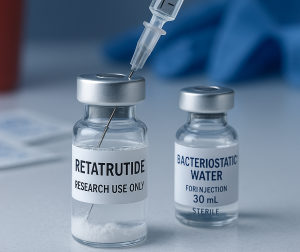
Do not treat the vial as a medicine that can safely be prepared for self-injection. The label may not reliably establish identity, potency, sterility or storage history.
This is particularly important in the UK because retatrutide is not a routine, authorised prescription weight-loss medicine. The MHRA has reported seizures involving unlicensed weight-loss medicines, including retatrutide, and has warned about the risks associated with unlicensed products.
If you already have an unknown vial
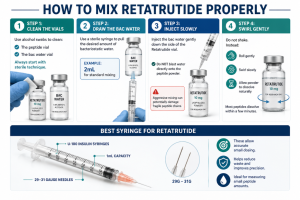
Do not inject it simply because the packaging appears professional or a seller has provided mixing instructions. If you have already used an unlicensed product and feel unwell, seek medical advice promptly and tell the clinician what you used, how much you believe you used and when.
Why is DIY retatrutide reconstitution risky?
The risk is not limited to getting the arithmetic wrong.
The product may not contain what the label says
An online vial may have uncertain identity or concentration. A claimed “10 mg” label does not independently prove that the vial contains 10 mg of retatrutide.
The product may not be sterile
Injectable products require appropriate controls against microbial contamination and other impurities. Reconstituting a powder at home does not turn a non-pharmaceutical product into a sterile medicine.
The concentration may be misunderstood
A dose expressed in milligrams is not interchangeable with a volume marking on a syringe. The final concentration depends on the actual amount of active ingredient and the final volume. If either is uncertain, the calculation is uncertain.
Storage and stability may be unknown
An unlicensed product may have been exposed to unsuitable temperatures, light or handling conditions before it reaches the buyer. Even if a powder appears normal, visual appearance cannot confirm chemical stability or sterility.
Why it matters: a technically correct calculation cannot compensate for an unknown product.
Is there a standard retatrutide reconstitution ratio?
There is no single public, patient-facing reconstitution ratio that should be treated as a universal instruction for every retatrutide vial. Preparation depends on the specific investigational product, formulation, study protocol and manufacturing instructions.
Online discussions often present a particular volume of diluent as if it applies to every vial. That is an unsafe assumption. Different products may have different concentrations, excipients, container specifications and handling requirements.
For a clinical-trial participant, the correct instructions come from the authorised study team. For an unlicensed product, the uncertainty surrounding the product itself is the fundamental problem.
Can you use bacteriostatic water to reconstitute retatrutide?
You should not assume that a commonly discussed diluent is automatically suitable for a particular retatrutide product. The correct diluent, compatibility, concentration, storage conditions and beyond-use period should be determined by the authorised product information or clinical-trial protocol.
A product sold online with a separate vial of liquid does not prove that the two components are compatible or suitable for injection. Nor does the presence of a preservative make an unlicensed powder safe for human use.
What this means: “bacteriostatic” describes a property of a particular sterile diluent; it does not validate an unknown peptide product.
What is the difference between clinical preparation and DIY peptide mixing?
The difference is the entire quality-control system around the product.
In a regulated clinical setting, the investigational product is handled according to an approved protocol and controlled procedures. The study team can document the product’s identity, supply chain, storage and handling requirements.
DIY preparation starts with a different set of uncertainties: the source may be unclear, the label may be inaccurate, and the final preparation may not have been manufactured or tested as a medicine. This is why online “reconstitution calculators” cannot provide the same assurance as a regulated pharmaceutical process.
What are the most common retatrutide reconstitution mistakes?
Mistake 1: Treating every vial as identical
A 5 mg, 10 mg or 15 mg label does not automatically tell you the correct preparation method. The product’s formulation and authorised instructions matter.
Mistake 2: Confusing syringe volume with drug dose
A syringe marking indicates volume. It does not, by itself, tell you the amount of active drug present. That depends on the final concentration.
Mistake 3: Assuming a clear solution is safe
Appearance is not a sterility test and does not confirm identity or potency. A solution can look clear while still being unsuitable for injection.
Mistake 4: Copying a protocol from a forum
A protocol written for a different product, batch or research setting may not apply to the vial in front of you. Social-media instructions are not a substitute for authorised medical or research guidance.
What should you do if you want retatrutide for weight loss?
If your interest is driven by weight loss, the safer route is to separate the treatment goal from the unlicensed product.
- Check the current UK regulatory status.
- Look for legitimate clinical-trial opportunities if you are interested in investigational treatment.
- Speak with a qualified healthcare professional about authorised weight-management options.
- Do not use an online reconstitution guide as a substitute for a clinical protocol.
- Avoid unlicensed injectable products whose identity, sterility or concentration cannot be independently assured.
[Link to Retatrutide: How to Get It in the UK]
For people seeking treatment now, authorised weight-management medicines may offer a more appropriate route than attempting to prepare an investigational peptide at home.
[Link to UK weight-loss treatment options]
What are the pros and cons of online retatrutide reconstitution guides?
The apparent advantage
Online guides can appear convenient because they provide simple calculations and step-by-step instructions. They may also make a complicated product seem easy to prepare.
The serious limitations
- They cannot verify what is actually inside the vial.
- They cannot confirm sterility.
- They may apply to a different concentration or formulation.
- They may encourage self-administration of an unlicensed medicine.
- They cannot replace clinical-trial or pharmaceutical instructions.
The most important trade-off is therefore not convenience versus complexity. It is convenience versus uncertainty about what is being injected.
Is retatrutide legal and authorised in the UK?
Retatrutide is not a routine, authorised UK prescription weight-loss medicine. UK regulators have also warned businesses about promoting unlicensed weight-management medicines and have taken enforcement action against alleged illicit manufacturing and distribution operations involving retatrutide.
The legal position surrounding a specific product can depend on the circumstances, but consumers should not assume that an online “research use only” label makes a product suitable for human use or creates a legitimate route to self-treatment.
The safest legitimate access route for an investigational medicine is an authorised clinical trial where the product is supplied and managed under the relevant research framework.
What are safer alternatives to DIY retatrutide preparation?
If your goal is medically supervised weight loss, discuss currently authorised options with a qualified UK healthcare professional. The right treatment depends on factors such as your health history, current medicines, eligibility criteria and the treatment’s regulatory status.
The UK now has authorised medicines for weight management, and the available options can change as regulators assess new products. For example, the MHRA announced approval of a semaglutide tablet for weight loss and weight management in June 2026, subject to specified eligibility criteria.
[Link to GLP-1 medication comparison]
Frequently asked questions about reconstituting retatrutide
Can I reconstitute retatrutide at home?
You should not use an internet protocol to prepare an unlicensed retatrutide vial for self-injection. If retatrutide is supplied through an authorised clinical trial, preparation and administration should follow the study’s official instructions. An online mixing guide cannot verify the product’s identity, concentration or sterility.
What liquid is used to reconstitute retatrutide?
There is no universal public answer that should be applied to every retatrutide vial. The appropriate preparation instructions depend on the specific authorised product or clinical-trial protocol. A commonly discussed diluent should not automatically be assumed to be compatible with an unlicensed peptide.
How much bacteriostatic water do you add to retatrutide?
Do not rely on a generic internet volume as a universal instruction. The correct preparation depends on the product’s formulation and authorised instructions, while an unlicensed vial may have uncertain contents and concentration. If you are participating in a clinical trial, follow the instructions provided by the authorised study team.
Can you mix retatrutide with sterile water?
You should not choose a diluent based solely on online advice. Compatibility, sterility, formulation and storage requirements must be established for the specific product. A sterile liquid does not make an unlicensed peptide product safe or authorised for injection.
How long does reconstituted retatrutide last?
There is no single safe shelf-life that can be applied to every product or preparation. Stability depends on the formulation, container, storage conditions and validated product data. Do not assume that an internet post’s storage timeframe applies to an unknown vial.
Is retatrutide reconstitution the same as semaglutide or tirzepatide reconstitution?
No. Different medicines have different formulations, approved presentations, instructions and regulatory status. A preparation method used for one medicine should never automatically be transferred to another investigational product.
What should I do if I already injected reconstituted retatrutide?
If you feel unwell, seek medical advice promptly and be honest about the product and amount used. Keep any packaging or product information available if possible, as details about the source, label and timing may help a healthcare professional assess the situation.
The bottom line on how to reconstitute retatrutide
For UK consumers, the safest answer is not to self-reconstitute an unlicensed retatrutide powder using an online protocol. Retatrutide remains an investigational medicine, and legitimate clinical-trial use is governed by controlled procedures rather than generic internet instructions.