
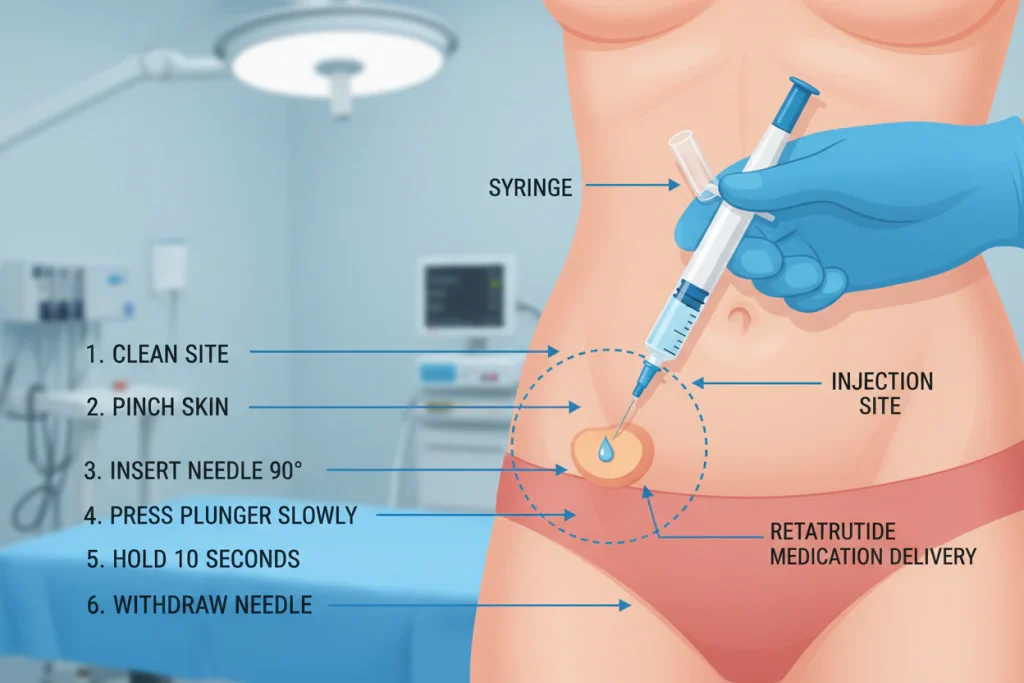
How do you take retatrutide?
Retatrutide is currently an investigational medicine, not a routine UK prescription weight-loss treatment. In clinical research, it has been studied as a once-weekly subcutaneous injection under a defined protocol, including controlled dose escalation in some trials. People should not copy trial dosing or use unlicensed online products without authorised medical supervision.

Why are people searching for how to take retatrutide?
If you have searched “how to take retatrutide”, you may have seen claims about its potential for significant weight loss and then encountered online discussions about vials, injection schedules and dose escalation.
The problem is that online instructions can make an investigational medicine look like an ordinary prescription product. Retatrutide is still being studied, and the way it is administered in a clinical trial is not the same as a general public self-treatment protocol.
In the UK, the distinction matters even more because the MHRA has taken enforcement action involving unlicensed weight-loss medicines, including products containing retatrutide. A vial purchased online should not be assumed to be an authorised medicine simply because it has professional-looking packaging.
What do you need to know about retatrutide first?
Retatrutide, also known as LY3437943, is an investigational drug candidate designed to activate GLP-1, GIP and glucagon receptors. This three-pathway mechanism is why it is often described as a triple agonist.
ClinicalTrials.gov records describe retatrutide studies as once-weekly subcutaneous treatment, with some trial arms using structured dose escalation to assess tolerability. Those research schedules are study-specific and should not be treated as a universal prescription for everyone.
A UK MHRA paediatric investigation-plan record also lists retatrutide as a solution for injection for subcutaneous use, showing ongoing regulatory development rather than routine public availability.
Quick answer: what is the safest way to take retatrutide?
- In a legitimate clinical trial: follow the authorised study protocol exactly.
- As a future licensed medicine: follow the official product information and prescriber instructions.
- From an unlicensed online vial: do not assume that internet dosing or injection guides are safe.
- Frequency in clinical research: retatrutide has been studied as a once-weekly subcutaneous treatment.
- Dose escalation: some research protocols use staged escalation, but schedules are trial-specific.
- If you are seeking weight loss now: discuss authorised treatment options with a qualified UK healthcare professional.
How is retatrutide taken in clinical trials?
Clinical studies have generally investigated retatrutide as a once-weekly subcutaneous injection. The exact dose, escalation schedule, treatment duration and monitoring requirements depend on the individual study protocol.
For example, one Phase 2 study record describes once-weekly subcutaneous retatrutide with different maintenance-dose groups and selected escalation schedules. That is useful for understanding how researchers are studying the medicine, but it is not a personal dosing guide.
Clinical trials also include screening, defined eligibility criteria and safety monitoring. Participants are not simply given a vial and told to copy a protocol from the internet.
What this means: the route and frequency studied in research do not automatically establish how an individual should use an unlicensed product.
Is retatrutide taken every day or once a week?
Retatrutide has been studied as a once-weekly subcutaneous treatment, rather than a daily injection. Clinical-trial protocols may use specific escalation schedules before participants reach a study-assigned maintenance dose.
The exact day and schedule are determined by the relevant clinical protocol or, in the future, by official prescribing information. People should not change the frequency themselves because a different schedule may alter exposure and tolerability.
Why it matters: “once weekly” describes the studied treatment frequency; it does not tell you what dose, product concentration or schedule is appropriate for a particular person.
Does retatrutide require dose escalation?
Some retatrutide clinical trials have used structured dose escalation, while other study groups have used different starting or maintenance regimens. The purpose is to evaluate efficacy and tolerability under a controlled research design.
That does not mean everyone should follow a dose-escalation schedule found online. A research protocol may be designed around a specific formulation, participant population and monitoring plan.
For example, a clinical-trial record may describe escalation from lower to higher study doses, but the existence of that schedule does not make it a self-administration instruction.
Where is retatrutide injected?
In clinical research, retatrutide is administered subcutaneously. That means the medicine is delivered into the layer of tissue beneath the skin rather than directly into a vein or muscle.
The correct administration technique, injection equipment and handling instructions should come from the authorised study team or official product information if a licensed product becomes available.
This is particularly important for unlicensed vials. Even if someone understands general injection technique, that does not confirm the identity, concentration or sterility of the product being injected.
Can you take retatrutide at home?
That depends on the authorised treatment pathway and product instructions. A future licensed medicine could potentially include patient self-administration instructions, but an investigational product supplied through a clinical trial must be used according to the study’s procedures.
A product purchased online is a different situation. The fact that a seller provides instructions for home use does not establish that the product is authorised, correctly manufactured or suitable for human injection.
The MHRA has warned about unlicensed weight-management medicines and reported a major seizure involving unlicensed products, including retatrutide.
What is the difference between taking retatrutide in a trial and using an online peptide?
The difference is not simply the injection itself. It is the controlled system surrounding the medicine.
In a legitimate clinical trial, the study has defined eligibility criteria, a protocol, product handling requirements and safety monitoring. The investigational product is supplied within a regulated research framework.
With an online “research peptide”, important questions may remain unanswered:
- Is the substance actually retatrutide?
- Is the stated concentration accurate?
- Was the product manufactured under appropriate controls?
- Has sterility been assured?
- Was it stored correctly?
- Is it legally authorised for human use?
What this means: knowing how to inject does not eliminate uncertainty about what is being injected.
What are the main risks of taking unlicensed retatrutide?
Unknown identity or concentration
An online label may not independently verify the contents of a vial. A claimed amount of active ingredient is not the same as laboratory-confirmed pharmaceutical quality.
Sterility and contamination
Injectable products carry risks if manufacturing or handling controls are inadequate. A professional-looking vial cannot confirm sterility.
Gastrointestinal side effects
Clinical studies of retatrutide have monitored tolerability and adverse events, including gastrointestinal effects. The frequency and severity of side effects can vary depending on the study regimen and individual participant.
Unsupervised dose changes
Increasing the dose because weight loss appears slow, or taking an extra injection after a missed dose, can create avoidable risks. A clinical protocol exists precisely to define how treatment is managed.
What are the most common mistakes people make when taking retatrutide?
Mistake 1: Treating trial results as personal instructions
A clinical study may use a particular dose, escalation schedule and monitoring system. That does not mean the same regimen is appropriate for every person.
Mistake 2: Assuming “once weekly” means any weekly schedule is acceptable
Frequency is only one part of a treatment regimen. Product concentration, dose, timing and clinical circumstances also matter.
Mistake 3: Buying an online vial because it looks pharmaceutical
Packaging, labels and certificates displayed online cannot independently prove that a product is authentic, sterile or authorised.
Mistake 4: Combining weight-loss medicines without medical advice
Combining medicines that affect appetite, glucose regulation or gastrointestinal function can create additional safety concerns. Treatment decisions should be made with a qualified healthcare professional.
What should you do if you want to take retatrutide for weight loss?
If your goal is weight loss, the safest sequence is:
- Check the current UK regulatory status of retatrutide.
- Look for legitimate clinical-trial opportunities if you are interested in investigational treatment.
- Discuss your weight-management goals with a qualified healthcare professional.
- Consider currently authorised treatment options where appropriate.
- Avoid copying unverified online dosing, reconstitution or injection protocols.
[Link to How to Get Retatrutide in the UK]
If you are seeking treatment now, an authorised weight-management option may be more appropriate than attempting to obtain an investigational medicine through an unofficial source.
[Link to UK Weight-Loss Treatment Options]
What are the pros and cons of retatrutide’s current treatment status?
Potential advantages
- Once-weekly research administration: clinical studies have investigated a weekly subcutaneous schedule.
- Distinct mechanism: retatrutide targets GLP-1, GIP and glucagon receptors.
- Active clinical development: multiple studies continue to assess efficacy, safety and potential uses.
Important limitations
- It is not a routine UK prescription weight-loss medicine.
- Clinical-trial dosing is not a DIY protocol.
- Long-term safety and regulatory status remain important considerations.
- Unlicensed online products may carry additional risks involving identity, potency and sterility.
Is retatrutide legal and authorised in the UK?
Retatrutide is not currently a routine, generally available UK prescription weight-loss medicine. The MHRA has warned businesses about promoting unlicensed weight-management medicines and has taken enforcement action involving unlicensed products containing retatrutide.
The existence of ongoing regulatory work does not mean that a medicine is already authorised for general prescribing. The MHRA’s July 2026 record for retatrutide concerns a paediatric investigation plan and lists the active substance and intended pharmaceutical form; it is not itself a marketing authorisation for routine patient access.
[Link to Retatrutide: How to Get It in the UK]
What are the safer alternatives if you want weight-loss treatment now?
If you want medically supervised weight loss, speak with a qualified UK healthcare professional about options that are currently authorised and appropriate for your circumstances.
A clinician may consider your medical history, BMI, existing conditions, current medicines, treatment goals and eligibility for particular services or medicines. The best option is not necessarily the medicine with the most impressive headline trial result.
[Link to GLP-1 Medication Comparison]
Frequently asked questions about how to take retatrutide
Can you take retatrutide once a week?
Clinical studies have investigated retatrutide as a once-weekly subcutaneous treatment. However, the exact dose and escalation schedule depend on the clinical-trial protocol. People should not treat a trial schedule as a personal prescription or copy an online protocol for an unlicensed product.
Do you inject retatrutide every day?
No, clinical studies have generally investigated once-weekly rather than daily administration. The precise schedule is study-specific, and future approved product instructions could define the authorised regimen. Do not increase the frequency based on online advice.
Where do you inject retatrutide?
In clinical research, retatrutide is administered subcutaneously, meaning beneath the skin. The authorised study team or official product instructions should provide the appropriate administration guidance. An online seller’s injection instructions should not be treated as equivalent to regulated medical guidance.
Do you need to increase the retatrutide dose gradually?
Some clinical trials use structured dose escalation, while different study arms may follow different regimens. Escalation is part of a controlled research protocol and should not be copied from a trial record or social-media post without medical supervision.
Can I take retatrutide at home?
That depends on the authorised treatment pathway. Clinical-trial participants must follow the study’s instructions, while an online unlicensed vial should not be assumed to be safe for home use. The MHRA has taken action against unlicensed weight-loss products containing retatrutide.
Can you take retatrutide with other weight-loss medicines?
Do not combine retatrutide with other weight-loss medicines without advice from a qualified healthcare professional. The safety of combinations depends on the specific medicines, doses, medical conditions and clinical context. An investigational treatment should not be added to an existing regimen based on internet advice.
What happens if you miss a retatrutide dose?
There is no universal public missed-dose instruction that should be applied to every investigational retatrutide regimen. A clinical-trial participant should follow the study team’s instructions. If a licensed product becomes available, its official patient information would provide the relevant missed-dose guidance.
Is retatrutide approved for weight loss in the UK?
Retatrutide is not currently a routine UK prescription weight-loss medicine. It remains under clinical development, with ongoing research and regulatory activity. The MHRA record published in July 2026 concerns a paediatric investigation plan, not general marketing authorisation.
The bottom line on how to take retatrutide
The clearest answer to “how to take retatrutide” is that clinical research has studied it as a once-weekly subcutaneous treatment, sometimes with protocol-defined dose escalation. That information should not be converted into a DIY dosing or injection plan for an unlicensed product.
If you are interested in retatrutide, the legitimate routes are authorised clinical research or, if regulatory approval is granted in future, a properly licensed prescription pathway. For weight loss treatment now, discuss currently authorised options with a qualified UK healthcare professional.
Schema type: Article + FAQPage